A well-built cabinet comes down to four things you can inspect: a 3/4-inch plywood box (not thin particleboard), solid-wood dovetailed drawer boxes on full-extension soft-close glides, six-way adjustable soft-close hinges, and sturdy joinery with a full back panel. These details - far more than the door style or finish - decide whether your cabinets still look and work great in 15 to 20 years. When you compare quotes, ask for these specs in writing; the answers separate a lasting kitchen from a bargain that ages fast.
Key takeaways: Judge cabinets by box material, drawer boxes, hinges, and joinery - not just the door. Plywood beats particleboard; dovetailed solid-wood drawers beat stapled ones; adjustable soft-close hardware is a must. Get the specs in writing. See how we build or get a planning range.
The cabinet box: your foundation
Tap to expand
The cabinet box: your foundation
The box (the carcass) is the structure everything else hangs on, and it is where cost-cutting hides. The best boxes use 3/4-inch furniture-grade plywood, which holds screws securely, resists moisture, and won't sag under a stone countertop or a loaded shelf. Cheaper boxes use particleboard or thin MDF, which can swell if water gets in, strip out at screw points, and bow over time. In Idaho's dry climate the difference is less about swelling and more about strength and screw-holding - a plywood box simply stays square and solid longer.
Also check the back panel: a full 3/4-inch (or at least substantial) back lets installers anchor firmly into wall studs and keeps the box from racking. A flimsy stapled-on back is a red flag.
Drawer boxes: the clearest quality tell
Tap to expand
Drawer boxes: the clearest quality tell
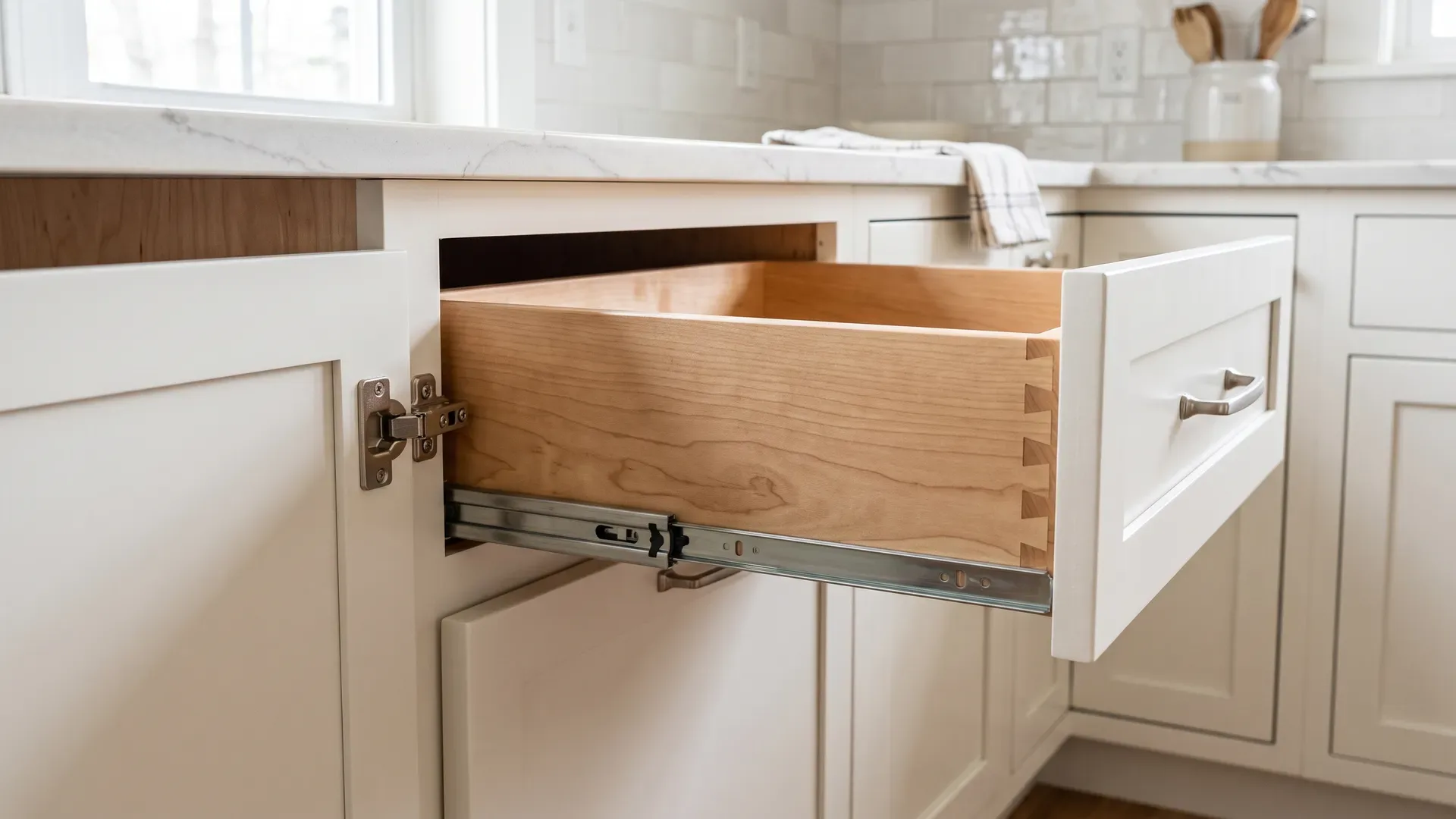
If you only inspect one thing, open a drawer. A quality drawer box is solid wood, joined with dovetails, riding on full-extension, soft-close undermount glides rated for real weight. Dovetail joints interlock and hold up to decades of daily open-and-close; stapled or glued particleboard drawer boxes loosen, sag, and eventually fail. Full-extension glides let you reach the very back of the drawer, and soft-close means no slamming. This single feature is the most reliable predictor of how "expensive" a cabinet feels day to day.
Hinges and glides you don't see
Tap to expand
Hinges and glides you don't see
Hardware is the mechanism of the kitchen. Look for six-way adjustable, soft-close concealed hinges from a reputable maker. Six-way adjustability means an installer can perfectly align every door - and you can nudge them back into alignment years later - in three planes. Soft-close protects the doors and your ears. Cheap fixed hinges cannot be fine-tuned, so doors drift out of alignment and there is little you can do about it. The same logic applies to drawer glides: quality, weight-rated, soft-close undermounts are worth every penny.
Joinery and assembly
Tap to expand
Joinery and assembly
How the box is held together matters. Dowel or dado joinery (where panels seat into grooves) plus glue and mechanical fasteners create a rigid, square box. Staples alone into particleboard do not. On face-frame cabinets, look for solid hardwood frames; on frameless cabinets, the thicker panels and precise joinery do the structural work the frame would otherwise provide. Either way, the box should feel solid and stay square when you press on a corner.
The 60-second quality inspection
Tap to expand
The 60-second quality inspection
Whether you are in a showroom or reviewing a sample, run this quick check:
- ☐ Knock the side panel - plywood sounds solid, particleboard sounds dull and hollow
- ☐ Open a drawer - solid wood? dovetails? full extension? soft close?
- ☐ Wiggle a door - snug hinges, no rattle; ask if they are six-way adjustable
- ☐ Check the back panel - substantial and screwed, not thin and stapled
- ☐ Look inside - clean edges, finished interior, no exposed raw particleboard
- ☐ Ask for the specs in writing - box material, drawer construction, hinge brand
Quality tiers at a glance
Tap to expand
Quality tiers at a glance
| Component | Budget build | Quality build |
|---|---|---|
| Box | Particleboard / thin MDF | 3/4" plywood |
| Drawer box | Stapled particleboard | Dovetailed solid wood |
| Glides | Side-mount, partial extension | Undermount, full-extension soft-close |
| Hinges | Fixed or basic | Six-way adjustable soft-close |
| Back panel | Thin, stapled | Substantial, screwed to studs |
Shelves, interiors, and edges
Tap to expand
Shelves, interiors, and edges
Open a cabinet and look inside - the interior tells you how much the maker cares about the parts you do not photograph. Quality shelves are thick enough not to bow under dishes, adjustable, and supported on solid pins rather than flimsy plastic. The interior should be cleanly finished, not raw particleboard that absorbs moisture and looks unfinished. Exposed edges should be neatly banded or veneered, not chipped or rough. Adjustable shelving matters more than it sounds: as your needs change, being able to reconfigure a cabinet keeps it useful for decades. These are small details individually, but together they separate a cabinet built to last from one built to a price.
Finish quality and how it is applied
Tap to expand
Finish quality and how it is applied
A finish is only as good as the prep and application beneath it. A quality painted finish is sprayed in a controlled environment over properly sanded and sealed surfaces, cured between coats, so it lays down smooth and resists chipping. A rushed, brushed-on finish over poor prep looks passable at first and then telegraphs every flaw within a year or two. You usually cannot watch the finishing happen, but you can ask how it is done and inspect a finished sample closely for a smooth, even surface with no brush marks, drips, or thin spots at the edges. On solid-wood painted doors, remember that fine seasonal movement at the joints is normal, not a defect. For more on choosing a finish, see our finishes and colors guide.
Assembled vs ready-to-assemble
Tap to expand
Assembled vs ready-to-assemble
How a cabinet arrives affects its strength. Ready-to-assemble (RTA) cabinets ship flat and are put together on site, often with cam locks and screws. Done well, RTA can be solid; done cheaply, the connections loosen over time. Pre-assembled cabinets are built and glued in a shop under controlled conditions, which generally yields a more rigid, durable box. Custom shops build and often pre-finish in-house, so the cabinet that arrives at your home is already a complete, square, tested unit. If you are comparing an RTA option to a shop-built custom cabinet, factor the assembly quality into the value, not just the sticker price.
Warranty as a quality signal
Tap to expand
Warranty as a quality signal
A company's warranty tells you how much it trusts its own construction. A meaningful workmanship warranty - one that covers the build, not just a token period - signals that the maker expects the cabinets to hold up. Read what is actually covered and for how long, and ask who you call if a hinge or drawer needs attention in a few years. At Boise Cabinet Co we back our cabinets with a written workmanship guarantee because we build them to earn it. A vague or missing warranty, by contrast, is worth asking hard questions about before you sign.
Why construction beats cosmetics
Tap to expand
Why construction beats cosmetics
It is easy to fall for a beautiful door and a trendy color, but the finish is the part you can most easily change or refresh later. The box, drawers, and hardware are not - they are the bones. A gorgeous door on a flimsy box is a kitchen that looks great in year one and feels tired by year seven. Reverse the priorities: buy the best construction you can, then choose the door and finish you love. That is how a kitchen stays satisfying for the long haul, and it is the standard we hold on every cabinet we build.
Pro tip: When two quotes are far apart in price, the gap almost always lives in construction you can't see. Ask both companies to put box material, drawer-box construction, and hinge brand in writing - then you are comparing apples to apples.
Construction red flags to watch for
Tap to expand
Construction red flags to watch for
Once you know what good looks like, the warning signs are easy to spot. A side panel that sounds dull and hollow when you knock on it usually means particleboard rather than plywood. Drawer boxes made of stapled particleboard, or drawers that only pull two-thirds of the way out, tell you the maker economized where it matters most. Doors that already sag or rattle in the showroom will only get worse, and fixed hinges that cannot be adjusted mean you will live with that misalignment. Inside, raw unfinished particleboard edges, thin shelves that already bow, and a flimsy stapled-on back panel all point to a cabinet built to a price rather than to last. Perhaps the biggest red flag is a company that cannot or will not tell you the box material, drawer construction, and hinge brand in writing. Quality makers are proud of these specs and share them readily; vague answers usually mean the details would not impress you.
None of this means the cheapest option is always wrong, but it does mean you should know exactly what you are buying. A well-built cabinet costs more up front and far less over a 20-year life, because you are not repairing sagging drawers, realigning drifting doors, or replacing swollen boxes. Spending a little more on construction and a little less on trend-driven extras is almost always the better long-term value. If you remember nothing else from this guide, remember to open a drawer and knock on a side panel before you sign anything, because those two seconds reveal more about a cabinet's real quality than any brochure or showroom display ever will.
How Boise Cabinet Co builds cabinets to last
Tap to expand
How Boise Cabinet Co builds cabinets to last
Boise Cabinet Co builds every cabinet with plywood boxes, dovetailed solid-wood drawers, full-extension soft-close glides, and six-way adjustable soft-close hinges - the details that keep kitchens, baths, and built-ins across Boise, Meridian, Eagle, and Nampa solid for decades. See our construction standards and the workmanship warranty behind them, then get a planning range or book a free consultation.